Semantography (World Writing): inspiration: Chinese Writing
Charles maintained that until he started living in Shanghai he never thought about creating a symbolic writing. It never occurred to him that it might be an antidote to the conflicts, pogroms and discrimination he experienced.
From the time of his arrival in Shanghai Charles was fascinated by Chinese writing. For a while he worked with a tutor to try to learn how to read the writing. From this point a direct line can be drawn to the invention of Semantography.
In his large book “Semantography (Blissymbolics)” Charles describes at length the inspiration for his invention.
China is fascinating and what fascinated me most were those queer and mysterious Chinese characters on shops and houses, in newspapers and books, and at night in thousands of multi-coloured neon tubes filling the sky and making it a beautiful sight out of a fairy tale. (SB 217)
Fascination turns to study.
I was fascinated by Chinese writing. I hired a teacher and tried to scale the great wall, the second great wall of China, as Lin Yutang called it, the ideographic writing of the Chinese. And as Lin Yutang predicted, I found myself in a world of wonder. A world, where people of different languages could read the same newspaper, the same book, even the same poetical verses. A world where poems written 2500 years ago in languages long dead, were still as fresh and beautiful in the languages of today, even when read in English, or, French or other European languages. I understood then Professor Ernest Fenollosa’s words, who wrote: “I believe that the Chinese written language has absorbed the poetic substance of nature… and has, through its very pictorial visibility, been able to retain its original creative poetry with far more vigor and vividness than any phonetic tongue.”(The Chinese Written Character as a Medium for Poetry, 1919) (SS 58-2/3)
I could read shop signs. I could read street names and notices. I could read headlines in the newspapers - but I read all this in my mother tongue, not in Chinese. Later on, the familiar words of my language disappeared in my mental translation of Chinese characters and I could visualize directly the real things depicted by the signs. I experienced the vividness and easiness of reading an ideographic writing. I became absorbed by those Chinese characters. I went “oriental”. Now I understood the saying of a great European professor at the University of Peking. Questioned about the future of the white man in China, he answered: “In 100 years, we will all be Chinese!” (SB 217)
Then I understood the unifying factor of the Chinese ideographic writing and why the efforts of past governments to introduce a phonetic writing have failed. But I understood too how the writing could standardize and unify the grammar and word order of different languages. Today with a large Chinese film industry and the acceptance of the Mandarin “dialect” as the national language, the unification of Chinese tongues has made great strides, but this is only possible because the ideographic writing has set a pattern of word order and grammar for all tongues spoken in China. (SB 217)
I began to understand what all sinologists know, that the main unifying factor, which brought about the largest nation on earth, which unified thousands of tribes, was the ideographic writing, which even invaders learned to read in their language and which made them Chinese in the end. Sinologists believe that a European nation would have been a reality many centuries ago, if Europe had a universal writing, which Englishmen and Frenchmen, Germans and Russians, Spaniards and Bulgarians and all the other nations could read and understand in their own language. The sinologist Basil Hall Chamberlain prophesied in 1904: “Ideographic writing will surely achieve the final victory over phonetic writing!” (SS 58-3)
After one year of study I gave up learning. I found Chinese writing a highly cumbersome and complicated affair, overloaded with archaic symbols, arbitrary to a great extent. But the wisdom contained in some characters held me in a spell. Besides I experienced a strange feeling, such as any foreigner may experience who tries to penetrate that great barrier, which Lin Yu-tang called the second Great Wall of China, the Chinese writing. (SB 217)
When I arrived in Shanghai 2 ½ years ago I was fascinated by the curious and wondrous Chinese characters and I started painfully with brush and ink to penetrate the mysteries of this unique hieroglyphic writing. One factor captivated me completely: that different people in East Asia who speak different languages are able to read books in Chinese writing, for instance about Confucius, in their own language. I believe that the common cultural traditions of the peoples of East Asia is based on this factor. (SS 104-02)
In Vienna, I had done scientific library research for years, and I realized the great handicap for science, produced by scientific publications in too many languages. I realized too, that the peoples of this planet stick to their mother-tongue and won't take to Esperanto or any other foreign language. It was exactly Shanghai, the most international city of the world, where I saw more than 22 different nations speaking their languages at home and among their own community, and resorting to the scantiest vocabulary for making business with the other people. (SS 58-3)
“This is it!” I said to myself, “an ideographic writing, very simple, but scientifically constructed, which laymen and scientists could read in their mother-tongue.” And I realized there and then that my opportunity had come. (SS 58-3)
How would it have been, I pondered, if by some remarkable chance in the history of mankind a similar writing would have existed in Europe. Then Dante, Moliere, Shakespeare, Goethe and all the others would have written their great works in such a writing and people from the southern-most point of Spain up to the north-cape in Norway would have been able to read these works in the “original” without a translation. A thought almost beyond our imagination! (SS 104-02)
Then I remembered my work as a research chemist in Europe. For months and years I had to work in university libraries. I had to read thousands of patent specifications, reports, dissertations, articles and books. Although in more or less fair command of four major European languages I experienced great difficulties and I realized the benefit of Latin for science in the past and the great handicap of the language Babel for the science of today. I had my own experiences in the laboratory about the necessity of a world-wide information service, unifying all scientists in all countries. (SB 217)
I forgot to tell that I had started a number of lectures on various subjects, for instance the Relativity Theory of Einstein, the discovery of electromagnetic waves by Hertz, also a Jewish man, and these lectures I delivered to Jewish audiences in the Jewish Club which was frequented by the old Jewish community (mostly from Russia) and in Hongkew to the new Jewish community, the refugees of this war. In addition, I wrote some articles for the Jewish weekly “Our Life.” All these activities came in handy when I suddenly got the idea of my lifetime. I have told about it in detail in the next paper “Semantography, my Life in China and afterwards” so I shall not repeat myself here. Enough to say that I was fascinated by those curious Chinese characters , and I hired a Chinese teacher to teach me something about them. I then realized that they are unduly complicated and that they could be very much simplified. I was very much impressed by the advantage of the Chinese characters that they could be read by Chinese who speak different languages or dialects, unintelligible to each other. Indeed, whenever I passed a newsstand I tried to read the headline of the Chinese paper in my mother tongue German and was happy when I could understand them. Often, in the evenings, Claire and I would go for a walk along the streets and I would take great fun in translating to Claire the names of the shops which were very flowery, just as China itself could be expressed and was expressed by the characters of flower and kingdom, meaning the flowery kingdom. Some of the shops had such titles as “The most beautiful shop in Shanghai,” “The most prosperous business,” “The best and cheapest shop” and the like. The idea occurred then suddenly to me that perhaps a modern symbol writing could be devised which indeed would be understood in all languages, such as the symbols of the mathematical numbers, and the pictographs for road warning signs as CURVE, etc. However I realized that “ideas are two for a penny”, and whatever success a man has must be hard-won by hard work and diligence. All my life I wanted to create something which could be of help to mankind, but as the years of my life ran out I realized that I am not the stuff of which innovators and discoverers are made of. But now, the opportunity presented itself and I grabbed it. Moreover, it was a wonderful thing to take my mind off our daily worries, because the war went bad for the allies, and our fate in the hands of the Japanese was something fearful, to contemplate. And so I set to work.SS 210 - 65
Scholars have now stated that my work is the first practical realization of an idea of the great philosopher Leibnitz. His speculation was considered an impossibility for 300 years, And somehow, Leibnitz and I got the idea in the same way. Leibnitz learned from missionaries in China about the Chinese way of writing. John Locke had published his "Essays Concerning Human Understanding" and Leibnitz answered with his "New Essays Concerning Human Understanding". This is written as a dialogue between two men, representing Locke's and Leibnitz’s view. There Leibnitz developed his idea about a Characteristica Universalis, similar to the Chinese, but “better than theirs,” a simple picture writing for the human race, regardless of language barriers, a writing which would contain a simple semantics and logic, “to make our conceptions more real,” an auxiliary writing to be sure “without however renouncing ordinary writing,” To this, the representative of Locke is made to reply: “I think these thoughts will someday be carried out, so natural and agreeable appears to me this writing.” (SS 58-2)
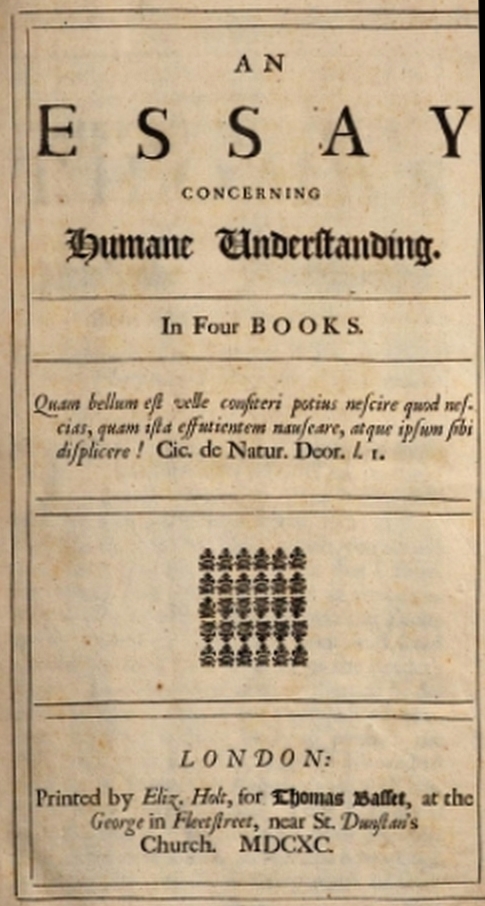
"An Essay Concerning Human Understanding", published in 1690 by John Locke.
.jpg "Leibnitz")
Gittried Leibniz, author of "New Essay Concerning Human Understanding", written in 1704.
In 1955 Charles attached the following note to Semantography Series 104:
(Note written in 1955. My knowledge about Chinese character writing was very superficial in 1943. The fact is that there might have been 80,000 different characters invented and accumulated by scholars in the past. The most detailed Chinese dictionary of Giles however, lists not more than 13,000 signs. Besides, Chinese typewriters contain at the utmost 2,500 characters and most of them have only 1,500 which are completely sufficient to express anything which people want to express. In the Chinese typewriter it takes a little longer time to find the character but then one pressing types a whole word and in fact Chinese typists are very quick. The 1,000 character schools are therefore completely sufficient for people who want to read the newspapers or other contemporary writing. The illiteracy in China is not caused by the complex Chinese writing but by the failure of the Government to provide schools and furthermore by the poverty of the peasants who need every helping hand in the field to stave off starvation. In Shanghai where even the lowliest coolie and rickshaw puller can afford to send his child to school, every child is literate by the age of 4 and I have seen and filmed something in Shanghai which I have not found anywhere in the world: street libraries. For the smallest coin children are able to select books from these street libraries as maintained by an old Chinese. I have many pictures to show these little children sitting around and reading avidly. Now to return to my lecture of 1943 and the foregoing paragraphs in which I assumed the impression of the foreigner that Chinese character writing is archaic and therefore bad.) (SS 104-5)