First Public Lecture on Semantography (New World Writing)
February 23, 1943, in the Shanghai Jewish Club
From Semantogrphy Series 103
In September, 1942, Charles started work creating a New World Writing. At first it was a toy, a plaything as a distraction from his daily troubles. However, soon it was a serious project so that by February 1943 he was prepared to give his first public lecture on his creation.
The lecture was promoted in a number of publications:
From the January 29, 1943, edition of the Shanghai Weekly "Our Life" Charles laid down the following challenge:
This seems incredible, but I will prove the truth in my lecture, arranged by the Cultural-Educational Committee of the Shanghai Jewish Club in the nearest future in the Club. Admission is free and everybody is invited to come and if he can, knock me down in the discussion. But I believe that my system will survive. I have experienced many times with joy that after I had explained to some of my friends a few elementary characters for a few minutes, they were immediately able to read new characters I presented to them. If you, my dear reader, do not believe me, please come, hear and see. SS 102-3
From the February 5, 1943, edition of the Shanghai Weekly "Our Life":
Mr. C.K. Bliss's lecture on "New World Writing", the introduction to which was published in the last issue of "Our Life" and provoked tremendous interest among our readers, will be delivered on Tuesday, February 23rd in the Shanghai Jewish Club. In course of this lecture Mr. Bliss will explain in detail his invented system of New World Writing - an Epoch making discovery. It is superfluous to mention that this lecture should attract the interest of the local public, for even apart from its most interesting topic Mr. Bliss's reputation as a lecturer is well established with our public. SS 102-3
From the February 19, 1943, edition of the Shanghai Weekly "Shanghai Jewish Chronicle":
Mr. C. K. Bliss will give an interesting lecture about his invention a ''New World Writing" in the Jewish Club, Tuesday 23rd February at 8:00 p.m, (admission free). His invention is based on the principles of Chinese writing. It can be learnt easily and it can be typed on a typewriter. It is not an auxiliary language like Esperanto but it makes it possible that a letter, a book, a newspaper could be read by anyone no matter what language he speaks. SS 102-3
Some notes on the first public lecture:
On the 23rd of January 1943 I gave my first public lecture before an audience of European and Chinese students. After explaining my system I asked for words and sentences to be translated into symbols. It was a success. SB 218
The following notes were written by me on the eve of my first lecture. As an introduction I refer to the foregoing issue which contains the article on “A New World Writing” which appeared in the Shanghai periodical “Our Life” on the 29th January 1943 (Semantography Series No. 102).
All hopes with regard to an auxiliary international language for common intercourse, like Esperanto, have not been fulfilled. Perhaps the time is not ripe for it, but an international medium of communication is a necessity for scientific research work. Many committees at scientific congresses have studied the problem but nothing has been forthcoming.
Why did Esperanto and Basic English fail? Apart from nationalistic interests it is difficult to acquire a new language when there are no opportunities which force you to exercise it daily. However, the necessity of an international language grows daily in this age of the train, motorcar and airplane. Countries and continents are brought nearer to each other.
If an international language has too many weak points which obstruct its success, we must try to eliminate as many weak points as possible. My idea is based on the fact that it is easier to read something in a foreign language than to speak it. Furthermore, success could be achieved if we could eliminate the weakest point in language learning, namely the learning of a new and strange sounding vocabulary.
When I came to Shanghai two and a half years ago, I was fascinated by Chinese characters and painfully through hard study I acquired the knowledge of about 1000 characters. Like most foreigners I believed at first that Chinese character writing has great disadvantages when compared with the alphabet. Later on, however, I realized the tremendous advantage of this writing. It gives immediately the meaning of the things instead of the sounds for them.
This great advantage has led to the fact that all over East Asia different people who speak different languages are able to read Chinese books, papers and even the old classics because they could read all this in their own Language. I believe that the common cultural traditions of East Asia are explained by this fact. I meditated what would have happened if such a character writing had been introduced ages ago in Europe. Then all the great poets would have written their immortal works in the same character writing. Then the works of Dante, Shakespeare, Moliere, Goethe and all the others could have been read by any literate person in Europe from Spain to Norway.
I was fascinated by this idea and considered the possibility of an international writing in which, for instance, this sign  would mean a table, and this sign
  would mean a chair, and this
  a house. And. it would have this meaning in every language and dialect which is spoken on this planet. If such an international writing could be invented then any literate person could write a letter which any other person could read in any of the languages used by those persons.
This idea came to me in September 1942 and I started to play with it for the mere fun of it. I started with simple signs, as for instance  a fish,
  a flower,
  a shirt, etc.
Soon I realized that my writing could be successful only if it were typable on a typewriter of the usual size. This prohibited the use of too many signs and I decided therefore to compose all my signs out of certain elementary signs.
I became interested in the subject because I experienced the difficulties which scientific researchers face when studying books and journals written in other languages than their own. From my boyhood on I was possessed with the urge to do something outstanding, something by which mankind could benefit, something entirely new which would make my life worth living. Here, so it seems to me, was something new. So far, I never heard, of any modern attempt to introduce a symbolic writing. The only reference I know was brought to my knowledge a few weeks ago by a friend. In the German periodical “Die Boettcherstrasse” of 1928 Mr. Gilbert a German teacher residing in Tokyo, proposed the use of Chinese characters throughout the world as an international writing. However, I could not share his view because the age-old Chinese writing is overburdened with complex characters which are very difficult to acquire (so I think). This accounts partially for the fact that many people in China cannot read and write. (Note: I have later abandoned this view. Chinese children learn easily the characters. The illiteracy of China is mostly due to the fact that the governments have not built and constructed schools. Another factor is the poverty of Chinese peasants, who need every hand of the family in the field. In Shanghai where earnings are good, the lowliest rickshaw puller sends his children to school.)
Right from the beginning I realized that modern character writing must not only be very simple, the meanings must also present themselves through a picture. There is, of course, the difficulty of making 10,000 to 20,000 different signs, an enormous task. However, I found a basis for great simplification in the system of Basic English (explain basic English), which consists only of 850 different words. With these 850 words another 7500 words can be composed. Those 7500 words are explained in detail in “The Basic Dictionary.” For instance, disembark could be expressed by go off a ship. 7500 words are completely sufficient for common correspondence. With them one can express almost everything, my task was therefore reduced to invent 850 signs only and to use these signs in connection with the Basic Dictionary to express more than 7500 meanings.
Starting from this assumption I was then astonished to find that even these 850 basic signs could be greatly reduced in numbers, because many words mean the opposite of each other, as for instance: in - out, cold - warm, open – closed, up-down, love-hate, wise-foolish, etc. I thought that if I could invent a. small sign which means the opposite, I could use one sign for two meanings. I found then other simplifications are possible and my amazement grew when I found how simple the matter could be evolved once a sensible system is introduced.
And now, enough with my introductory talk. Let me give you a first taste of my writing. Here are some signs and their meaning. (Note: A few signs shown in the following pages have been altered meanwhile. Nevertheless, most of what I invented in 1943 is found in my books written in 1947-1949).
And now, here are the line elements for my signs.

An ordinary typewriter has 42 keys. As the 22 elements shown above are sufficient to type any sign, I have keys free to introduce other elements, which I call composite elements, and which combine 2 and more elementary lines. This would enable quicker typing. Here are a few composite elements.

My idea is to discard the capital letters on a typewriter, and to leave only the small letters, the numbers and the marks. Consequently every name like Shanghai, every Christian name and surname, every international, scientific or technical word can be typed in normal alphabetical letters, using only the small letters. Indeed whole letters in normal writing could still be typed in ordinary words in any language using the alphabet. Only the capital letters are removed from my typewriter and the line elements substituted for the typing of the signs.
You may have thought that the typewriter would need a certain adjustment in order to put a certain element higher or lower, or a bit to the right or the left. Now, with any ordinary typewriter it is possible to shift the cylinder vertically by turning the knob at the end of it, or horizontally by shifting the lever provided for this purpose, or by pressing a key for shifting it back one space. The only adjustment my typewriter needs is a special lever for shifting the cylinder up or down, to the right or left, after which the cylinder returns to its first position. It is not necessary to describe in full such a lever, as the principal is well known and used in many different machines.
One of the things that Charles was accused of, during the conflict with BCI, was that he was too rigid in his thinking and too obstinate in how the symbols were to be formed. This document (Semantography Series 103) shows that Charles was indeed very flexible regarding his newly created system. He discarded some symbols from his original work and adopted a much more simplified syntax than was originally envisioned.
Here are some examples of the original system that were subsequently changed:
Indicators: 
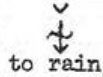 This indicator v is shaped like a v and means verb. If put on top of a character which is a noun it transforms the noun into a verb.
 This indicator is shaped like an A and indicates adjective. If put on top of a character it converts it into a quality (adjective).
(Note: I have later on changed these indicators, the first to mean eValuation, the second to mean Action).
 When we put our indicator for man on top of a character it indicates the man dealing with the meaning of the character as for instance: garden-gardener, field-farmer.
 This indicator is the female counterpart of the foregoing indicator. We have the man and women and consequently a female gardener. However, we can dispense with this indicator.
(Note: I have later on discarded both).
 This indicator is the sign for addition and means the plural and to add.
(Note: I have later abandoned the use of the plus sign for plural, and have adopted the multiplication mark instead.)
 This indicator means the whole of the same kind. It represents the multiplication mark. The ocean, sea, the working class, etc.
(Note: completely abandoned).
 This indicator on top of another sign means the representative word for a group of things: person, liquid, addition, subtraction, division, agriculture, industry, etc.
(Note: this sign indicating the mouth has later on been used in a different way to express representative words. The symbolization of addition, subtraction, etc. agriculture, industry, etc. has been simplified).
 This indicator means symbolic and it is used when the character meaning is used in an abstract (metaphorical) way only: The world of his ideas, the sun of his life, his mind was open to new ideas, etc. This is necessary because literal translation of words into other languages make no sense if the reader is not made aware that the word is used in a metaphorical way.
(Note: This symbolization has been abandoned in favour of a better one).
Pronouns

Possessive Pronouns

Note: Charles abandoned these pronouns to use the more common first, second and third person. For the possessive pronouns the + sign was dropped to the line on the bottom, indicating that your possessions are earthly.
Geometrical Classifier
 Classifier preceeds a symbol to indicate the class to which the symbol belongs.
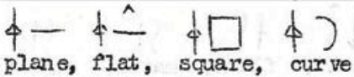
(Note: I have abandoned the use of the classifier for such meanings as before, after, above, beIow, through, long, short, begin, end, and others, because they have only this meaning in the sign shown. The classifier is not necessary. Later I altered the classifier for geometrical too.)
Concluding Comments
These explanations form the end of my lecture, and I shall now answer questions. There is I think one question which surely you are going to ask: “What are you going to do with this invention?” Well, nothing at present, and it is highly questionable whether if ever I would live to see my idea developed. I have given this lecture only to have a claim to history, in case later on someone else will be successful with it. I am perfectly sure that a system like this will be developed sooner or later, and already some signs in this direction are visible. For instance, in my business line: on home movie projectors of a certain brand which is exported throughout the world there are signs instead of words in different languages to indicate the use of the various knobs, levers, etc., as for instance in, out, lamp brighter or less bright, motor faster or slower, etc. These pictorial signs are affixed to the projector.
The younger ones among you may live to see an international system of signs adopted by all communication institutions and used on all trains, stations, buses, airplanes, ships, ports, etc. indicating the necessary information to everybody no matter what languages he speaks. Perhaps it might be my system which is adopted, but it would not matter if it were the system of someone else, as he and I are both only tools of the Creator.
After the lecture
From the February 26, 1943, edition of the Shanghai Weekly "Our Life":
Mr. C.K. Bliss delivered his long expected lecture on “New World Writing” - his own invented system on Tuesday, February 23rd at the Shanghai Jewish Club before a numerous and enthusiastic audience. SS 103-1
Mr. Bliss’s language consists of a number of extremely simple signs, the combination of which enables to express the 850 words of which, as we know, consists Basic English. Thus Mr. Bliss's system is based on Basic English, and as with the use of a Basic English Dictionary, which translates the meaning of 7,500 words into 850, one is able to read almost any book, so having learned the principles of the New Language which are extremely simple, one is able to express in it the most abstract words. SS 103-1
Mr. Bliss worked with chalk on the blackboard and left the audience dumbfounded with astonishment by expressing sentences readable in every language with a few curves and lines. SS 103-1
The lecture left a deep impression upon the audience, and our readers should look forward to Mr. Bliss’s further articles explaining in detail his system which he promised to contribute to “Our Life”. SS 103-1
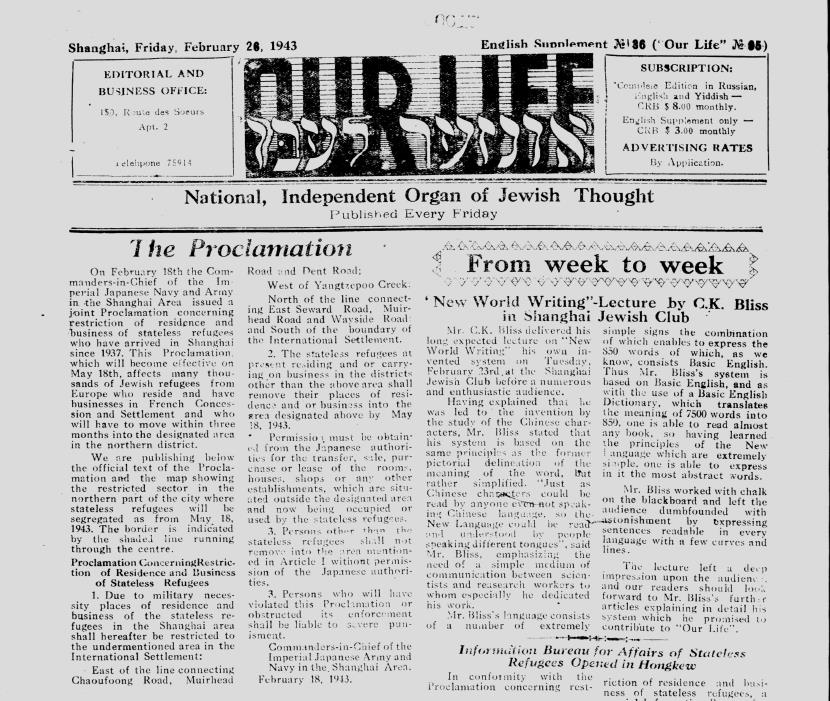
February 26, 1943 edition of "Our Life." Note the article on Charles' lecture is beside the "Proclamation" that all stateless refugees must move into the Hongkew Ghetto.