Semantography (World Writing): creating: lectures, interviews and articles
Immediately following the first public lecture all of Charles' energy (and that of his fellow refugees), was focused on finding accommodation and maintaining an income to keep from starving. However, once the move was made he returned to work on his World Writing. Over the next three years he gave interviews, wrote articles and made presentations on his invention.
Charles made the following general comment on his lectures:
My idea of a new and modern symbol writing found great appreciation among the Chinese and European communities of Shanghai, and I lectured to groups, and students at the university, to the Rotary Club, and other societies. They all urged me to carry on and write a book about it. They all knew that I was onto a good thing, because they knew that the archaic script of the Chinese nevertheless works beautifully in commerce, in technology and industry, and even in science. I closed every lecture in Shanghai with the words, that “if my modest work could indeed bring mutual understanding to people speaking different languages, then I shall bless the moment when I set my foot on the soil of China.”(SS 210-71)
American Rotary Club, April 1946
The war ended and peace came to Shanghai. In May 1946 (note: I think this is an error here. The Rotary Club lecture definitely occured in April 1946.) I spoke before U.S. Army officers and then before the Rotary Club of Shanghai. I shall never forget their cheers. ”Stick to it! Write a book about it! You have really got something!” (SB 218/219)
I went home through the streets of Shanghai, oblivious of all the rickshaws, the crowds, the-traffic. I trod on clouds. (SB 218/219)
When the war ended, Shanghai woke up, for the last time, to its former self. Ships loaded with goods filled the river and there were jobs galore and money to make. I had given some lectures on my work previously. Now the educational branch of the United States Force China Theatre invited me to a lecture. So did the reinstated American Rotary Club. They cheered me after my speech and many said: “Stick to it!” “Don't drop it!”, “You have got something!”, “Write a book about it!” SS 58-3
After the Rotary Clup lecture the following was reported: "In thanking the speaker on behalf of the Rotary Club, Mr. Wm. Yinson Lee said that Mr. Bliss's system appeared to be the nearest approach to a universal written language he had seen and he was to be congratulated on his achievement. He invited Mr. Bliss to repeat the lecture at the next meeting of the Shanghai “Y” Men’s Club,” which will take place tomorrow (Tuesday).(SS 104-11)
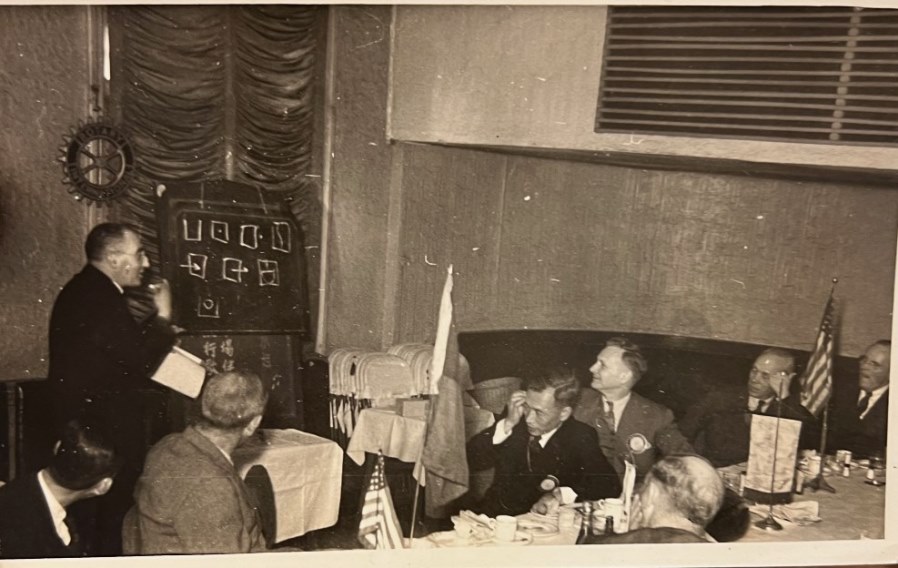
Rotary Club lecture 1946
“Y” Men’s Club, April, 1946
Following this lecture the Shanghai Press brought out an article:
He says that it is crazy idea, but C. K. Bliss, photo-expert and chemist, wants the whole world to know about his invention of a new universal sign language, because “crazy ideas sometimes help the world.” (SS 104-11)
Repeating his lecture on “Universal Sign Language,” which he gave before the Rotary Club recently, at a regular meeting of the Y’s Men's Club yesterday, he related with enthusiasm before an amused audience that his system is derived from the roots of Chinese writing. (SS 104-11)
Taking a cue from the Chinese writing which originated from signs, Bliss has devised a simple system consisting of from 60 to 80 signs in all, which may be produced by a typewriter with only 42 keys. “These signs, simple as they are, can express anything, including the most abstract words,” he stated. (SS 104-11)
He declared that Mr. Ralph Mortenson, China representative of the American Bible Society, has asked him to translate the first chapter of the Old Testament. At the Y’s Men's meeting yesterday he employed his pet signs to express the first stage of creation. (SS 104-11)
“I am a photo-expert and chemist," he concluded, "but I feel my invention is so convenient and would save so much trouble for the world that I am willing to devote two years of my time in propagating this new method, which will help some people to understand each other. If the world doesn't want it, then I would go back to my own business.” (SS 104-11)
Asia Seminar, April, 1946
The was the last lecture given in Shanghai. An article appeared in the Shanghai Echo following the lecture:
“Mr. C. Bliss spoke in the Asia Seminar about the World Writing which he invented. He started by explaining the development of writing in general and spoke then about the advantages of a uniform writing for the whole world that means a writing which everyone could learn to read and understand without having to learn a foreign language and without making difficult mental efforts. The lecturer referred to the fact that the beginnings of such international communications are available for the intellectuals of all countries who can read mathematical equations, chemical formulae, technical abbreviations, etc. the meaning of which is clear to all of them though they pronounce the relevant words differently in whatever mother tongue they speak. Bliss has occupied himself with the creation of a writing the symbols of which communicate the meaning even to primitive people. A certain number of standard signs are to be learnt which have only one meaning and the same meaning for all mankind. A number of these standard signs (which altogether number not more than 500) are so-called classifiers which we know already from Chinese and Japanese writing. They enable anyone (who is not too much of a philosopher, as Bliss said) to express himself in an international medium of communication. (SS 104-12)
“Whether the invention of Bliss has a greater future than Esperanto could not be judged on the basis of this short lecture. However, everyone respected the intuition, the invention and the great amount of mental work which was necessary to bring this idea into a practical form. Bliss got therefore the applause of a highly interested audience. (SS 104-12)
U. S. Army Information and Education Section: lecture, March 4, 1946
This appears to have been a well attended lecture. An article appeared in the North China Daily News following the lecture:
The theory of a new sign language, which he described as “World Writing” was expounded last evening by Mr. C. K. Bliss, B.Sc., in a lecture to servicemen of the United States forces and civilians. (SS 104-9)
Inspired by his study of Chinese characters, Mr. Bliss claimed that his new system, which consists of sixteen known signs, 12 new signs and some sixty symbols which many as children have scribbled on paper, sets a new standard of language simplicity through character writing. (SS 104-9)
His experience as a research worker had shown him that science needs an international means of intercourse. At every scientific congress the same problem was brought up, but hitherto no solution had been found. Mr. Bliss hoped that his system might be the answer to the problem, or at least an indication to it. (SS 104-9)
A lively discussion concluded the lecture. (SS 104-9)
Shanghai Weekly "Our Life": Interview, October 1944
The six years’ contact of Jewish European emigration with Asiatic culture has resulted, as far as we know, only in one work of ingenious creation, namely, the “World Writing” of Mr. C. K. Bliss, a well-known lecturer. His invention is an international character-writing, inspired by Chinese writing system but scientifically simplified and able to be typed on an adjusted typewriter of ordinary size. Any book, paper or letter written in this new character-writing could be read by everybody, no matter what language he speaks. (SS 104-6)
As one and a half years have passed since Mr. Bliss published his initial article in “Our Life” (No. 91 of January 29, 1943) we asked him for an interview. (SS 104-6)
”Are you still enthusiastic about your idea?” (SS 104-6)
“More than ever. My international writing avoids the difficulty of learning new vocables and descrying them (as necessary for Esperanto). Moreover, it meets a burning need of Science. Even the wealthiest University in the world is unable to purchase all the scientific books (high prized because printed in small editions) and subscribe to all scientific magazines, periodicals, reports or dissertations. Moreover, the greater part of them would be inaccessible to the students being written in languages unknown to them. Imagine, however, every scientific book in my writing, readable by every student in the world in his own language and available for less than a five-cent detective story.” (SS 104-7)
Note: Purpose of the symbols is still a means of scientific communication.
”Have you given any more lectures after your first lecture in the Jewish Club?” (SS 104-7)
“By invitation of Dr. Friedrichs I spoke before the Hongkew Medical Society and was deeply moved by their enthusiasm. They all, being men of science, know how difficult it is to look up a medical report written in an unknown language. Discouraging, however, was another lecture given before Jewish intellectuals, and most distressing was a lecture delivered to Jewish youth in Hongkew.” (SS 104-7)
Note: These three lectures are occasionally referenced in other sources. Unfortunately, I have not been able to locate more information on when they occurred or what happened at these lectures.
“Are you discouraged by this?”(SS 104-7)
“Not a bit, on the contrary! Think, for instance of the year 1843. Our great grandfathers writing with goose-quilts and completely unaware of future typewriters, telegraph and high-pressure salesmanship! At that time Gabelsberger started to draw snail strokes, points and curls and called it “Stenography” (short-hand). '”What for?” asked the people; “he is crazy…”(SS 104-7)
Hongkew Medical Society: Lecture, Sometime between January 1943 and October 1944
The lecture most enthusiastically received was given to the Hongkew Medical Society, a group of doctors from Europe which was under the leadership of Dr. Friedrich who became my ardent friend and supporter.(SS 104-3)
Jewish Intellectuals: Lecture, Sometime between January 1943 and October 1944
Jewish Youth: Lecture, Sometime between January 1943 and October 1944