Semantography (World Writing): creating: original audience
The original intended audience was scientific researchers and librarians. However, this target audience quickly expanded to all people.
An article in “Our Life” concerning Charles’ first lecture on New World Writing included the following statement: “Just as Chinese characters could be read by anyone even not speaking Chinese language, so the New Language could be read and understood by people speaking different tongues”, said Mr. Bliss, emphasizing the need of a simple medium of communication between scientists and research workers to whom especially he dedicated his work. (SS 104-01)
There is a group of people, perhaps the most valuable ones, who need. an international medium of understanding as much as the hungry needs a bite of bread. (SS 104-01)
These are the scientific researchers who work in thousands of laboratories, university institutes, hospitals and industrial centres of the whole world, with only one aim before them: a better, easier and healthier life for the coming generations. (SS 104-02)
Perhaps the most important department of those research institutions is the library. Here the experiences of researchers are collected; here are the journals which report about the last research results. Everyone who has worked in a scientific field knows that before the start of any research many weeks and months of library research are necessary. In reality however no library can acquire all the newest books and all the necessary journals. The prices of acquisition are high because of the small editions and then there are the many languages. I myself have for a number of years done research in technical libraries in a number of European capitals. I was able to get through English, French and Italian publications but I was completely helpless when I found that the relevant report I was looking for was available in volume 27, year 1903 issue 34 page 465 of ”Reports of the Swedish University Upsala.” (SS 104-02)
It was better in the so-called dark ages. In the scholarly world Latin was spoken and written. Students were able to take part in any University of Europe and could read any book. Galileo could correspond with Kepler, and Kepler with Copernicus. It must be possible to re-create this progressive state of affairs. (SS 104-02)
The creation of a simple and easy international medium of communication would mean the creation of a wonderful tool which could advance mankind by decades and centuries, in its endeavours for progress and mutual understanding. Here then is my idea built upon the oldest principles, which removes completely the difficulty of learning a new language. It is not a language and a writing, but a writing only. Many emigrants know that it is much easier to read an English book but one has great difficulties to speak English fairly well. (SS 104-02)
How would it have been, I pondered, if by some remarkable chance in the history of mankind a similar writing would have existed in Europe. Then Dante, Moliere, Shakespeare, Goethe and all the others would have written their great works in such a writing and people from the southern-most point of Spain up to the north-cape in Norway would have been able to read these works in the “original” without a translation. A thought almost beyond our imagination! (SS 104-02)
Then I remembered my work as a research chemist in Europe. For months and years I had to work in university libraries. I had to read thousands of patent specifications, reports, dissertations, articles and books. Although in more or less fair command of four major European languages I experienced great difficulties and I realized the benefit of Latin for science in the past and the great handicap of the language Babel for the science of today. I had my own experiences in the laboratory about the necessity of a world-wide information service, unifying all scientists in all countries. (SB 217)
Man has invented and constructed the most marvelous things, which are of benefit to all. It seems , therefore, that he should also be capable to invent a system for common intercourse between the nations. And it is, perhaps, significant that it was a Jew, representative of a nation which is dispersed among all nations of the world, Dr. Zamenhof, who invented in 1883 a new auxiliary language, Esperanto, to link all nations in common and understanding. Esperanto means "Hope", but today, 60 years later, we must admit that his hope has not been fulfilled, yet. National prejudice and pride account for this failure, no doubt, but mankind has no time to wait a few hundred years more until the seed of Esperanto will strike root. There are men among all nations who are simply craving for an international means of communication, and whose work is of the greatest importance to mankind. These men are Scientists and Research Workers all over the world, working in thousands of laboratories, universities, hospitals and industrial centres and busily engaged in scientific research work with only one aim in view: a better, easier and healthier life for the future generations of man. The most important part in these Research Institutes is the Library, in which is preserved the wealth of experience of the Scientists of all ages, and the scientific contemporary periodicals written in all languages which contain data about the scientific work which is being done all over the world. Only one who is himself engaged in scientific research can realize the tremendous importance of a scientific report about the same work done by somebody else. These few lines can save him years of labour and costly experiments, acquainting him quickly with the result achieved by another worker, who spent those years, labour and money to find out what the next scientist can use as a step to future work. (SS 102-1)
But the difficulty is that scientific periodicals and new scientific books are written in too many languages. Moreover, they are very costly because it is impossible to sell many copies and therefor e not every laboratory can afford them. In the Middle Age it was different. All scientists spoke and communicated with each other in Latin, and all scientific books were written in Latin. A student was able to attend any university in Europe, because everywhere the lectures were given in Latin. Galilei could write in Latin to Kepler, and Kepler could write to Kopernikus. That tremendous advantage has since been entirely lost. (SS 102-1)
It is, therefore, only natural that at Scientific Congresses the demand for an international means of communication between scientists has been raised and different Committees have been appointed to study this question. But, alas! - no headway ills been made, although Esperanto and Basic English have presented themselves as a ready tool. The whole question is as difficult as it is important. Everybody knows that to acquire a new language hard study, practice and, moreover, special opportunities are necessary. The most difficult things are the vocables, strange words which axe so difficult to learn and to remember. (SS 102-1)
But the difficulty is that scientific periodicals and new scientific books are written in too many languages. Moreover, they are very costly because it is impossible to sell many copies and therefor e not every laboratory can afford them. In the Middle Age it was different. All scientists spoke and communicated with each other in Latin, and all scientific books were written in Latin. A student was able to attend any university in Europe, because everywhere the lectures were given in Latin. Galilei could write in Latin to Kepler, and Kepler could write to Kopernikus. That tremendous advantage has since been entirely lost. (SS 102-2)
In 1953 Charles had a meeting with Julian Huxley. In Semantography Series 124 Charles recounts the interview. Part of this interview explores the application of Semantography to international communication.
Huxley: And how are you proposing to use these symbols for scientific communication?
BLISS: I have been director of the patent department of a large European firm. I handled thousands of patent specifications of' various countries, written in a variety of languages. I need not tell you about the great difficulties which scientists and doctors face, knowing that most important reports on research in their field are hidden away in scientific journals printed in languages they cannot read, Moreover, oven the richest universities cannot buy all the scientific journals in all the languages (of little use to those who cannot read them). The first thing I propose is an international science abstract, printed on small filing cards, the size of a post card. These cards should contain the title indicating the subject, and the result of the research in say 100 words, also all necessary reference data and the filing number according to the Dewey library system, already in use in most libraries.
Anglo American Universities should issue abstracts written in English and the symbols above each word. French Universities will write in French - and the symbols, etc., etc. Anyone who can read the language in which a report is written, need not to be bothered about the symbols. The others will read the symbols in their own language be it Hindustani or Danish or any other language.
These filing cards should be interchanged between universities, but every doctor or engineer, or scientist, every hospital, industry, institute could subscribe to the cards for their special field only. They would receive every month the batch from the international distribution centre and thus would know immediately what's going on in their field in the whole world.
Huxley: It would be a good thing, no doubt.
Bliss: And imagine the additional advantage. Two doctors speaking different languages could write letters to each other. So can an engineer, corresponding with a firm in another country. Phantastic as this may seem, we must realize that today every larger commercial or industrial firm uses an international ideography, complicated, cumbersome, illogical to the extent of madness - THE TELEGRAPHIC CODES. Radio-photo cables in Semantography can be read in any language.
(SS 124-4)
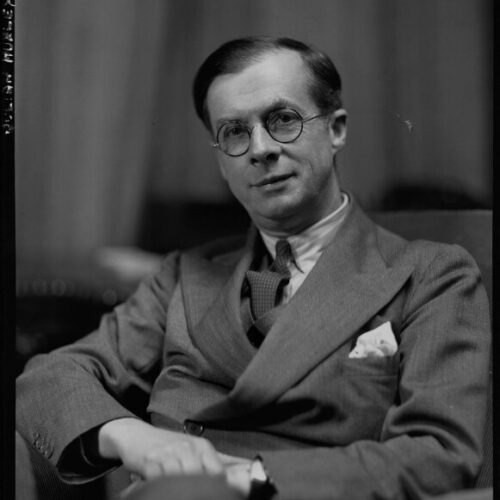
Julian Huxley, evolutionary biologist, first Director-General of UNESCO.