Hongkew Ghetto.
Jewish refugees are forced into an area which becomes known as the Hongkew Ghetto.
In all our misery and anxiety about our fate, there was one thing which I enjoyed. There were the various radio stations, Japanese, Chinese, Italian, German and before the Pacific war, also British and American stations and all of them brought the war news from their government. In addition we could buy German papers and read there all the tirades of Mr. Goebbels and the German war communique. After the British and American radio stations of Shanghai stopped working we could tune in to the Russian radio in Shanghai which brought the news in German and English. So, we could compare the reports from both sides and thus we could get a fairly accurate picture of how the war was going. But it was not good. True enough Hitler’s Blitzkrieg in Russia and elsewhere had been slowed down; still there was not a single allied victory onto which we could pin our hopes. (SS 210-64)
I had started a number of lectures on various subjects, for instance the Relativity Theory of Einstein, the discovery of electromagnetic waves by Hertz, also a Jewish man, and these lectures I delivered to Jewish audiences in the Jewish Club which was frequented by the old Jewish community (mostly from Russia) and in Hongkew to the new Jewish community, the refugees of this war. In addition, I wrote some articles for the Jewish weekly “Our Life.” (SS 210-65)
And now came the turn of the war. The first unbelievable news came from El Alamein, and then came Stalingrad. How wonderful it was to read in the official German paper in Shanghai that the War is going bad for Hitler. Suddenly our hopes of a new life sprang up. I began to sing in the morning when I shaved, I began to compose little war poems, and I recited and sang them to everyone. I have collected a number of them in the little pamphlet “Three Months of Hope” which is included in this issue. Three months only, because in February 1943 came a terrible shock. The Japanese forced the Jewish immigrants into a Ghetto. The reasons for this were not clear at the time. It was greed. Imagine that Mr. Yamamoto and his wife have been able to move into a beautiful apartment which belonged to a British national, now safely in the internment camp. He had to leave everything, the beautiful furniture, the kitchen ware, etc., etc. And now imagine the wild scramble of the Japanese upper-class people who had grabbed all apartments, all offices, and all shops that were to be grabbed. There remained so many more Japanese people who were still forced to live in their rather dingy quarters in the Japanese sector. A way had to be found to provide them with nice apartments in the Western section of the city, and why, yes, of course, why not grab the apartments and businesses of the Jews. A special department was created to deal with the situation, and sure enough they found a Jew, a Dr. Kohn who was born in Japan, was educated there, spoke and wrote the language fluently, and most of all, had a flair of a charlatan, who was ready to sell his brethren if a commission came into his pockets. There was great anxiety among the Jewish refugees from the First World War, the Community who still spoke Russian and Jewish, that is Yiddish. But apparently, they had to dig in their pockets and provide Dr. Kohn and other influential Japanese leaders with good money in order to be spared. Only we, the 18,000 refugees, we became (SS 210-65) the victims. It was clear from the beginning that what the Japanese wanted were our businesses and apartments in the western sectors, because that sector in Hongkew where about 5,000 poor refugees lived in small houses, rooms and factory dormitories was of no interest to the Japanese, and therefore they created the Ghetto there. So, the poor people among us in that sector remained where they were, only the others in the .western sectors were forced to move. I was a poor man myself, but I too lived in the Western sector, so the Japanese edict applied to me too. We were given three months’ time to hand over our businesses and apartments, and had to find living quarters in the “segregation area” ourselves. How we are going to make a living there, was something the Japanese did not bother. It was in a way worse than in an internment camp, because there you get some food and quarters. We had to find it ourselves, and this was worse, but better again, because we still had some freedom. (SS 210-66)
The Proclamation
- Due to military necessity places of residence and business of the stateless refugees in the Shanghai area shall hereafter be restricted to the undermentioned area in the International Settlement:
- East of the line connection Chaoufoong Road, Muirhead Road and Dent Road;
- West of Yangtzepoo Creek;
- North of the line connecting East Seward Road, Muirhead Road and Wayside Road; and South of the boundary of the International Settlement.
- The stateless refugees at present residing and/or carrying on business in the districts other than the above area shall remove their places of residence and/or business into the area designated above by May 18th, 1943.
Permission must be obtained from the Japanese authorities for the transfer, sale, purchase or lease of the rooms, houses, shops or any other establishments, which are situated outside the designated area and now being occupied or used by the stateless refugees.
- Persons who will have violated this Proclamation or obstructed its enforcement shall be liable to severe punishment.
Commanders-in-Chief of the Imperial Japanese Army and Navy in the Shanghai Area.
February 18, 1943. (SS 102-4)
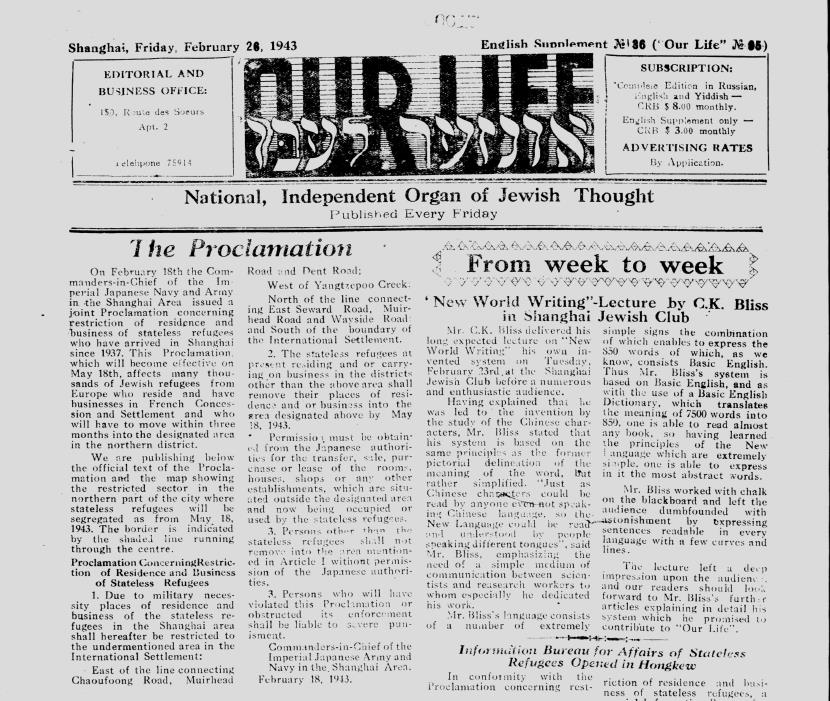
February 26, 1943 edition of "Our Life." Note the article on Charles' lecture is beside the "Proclamation" that all stateless refugees must move into the Hongkew Ghetto.
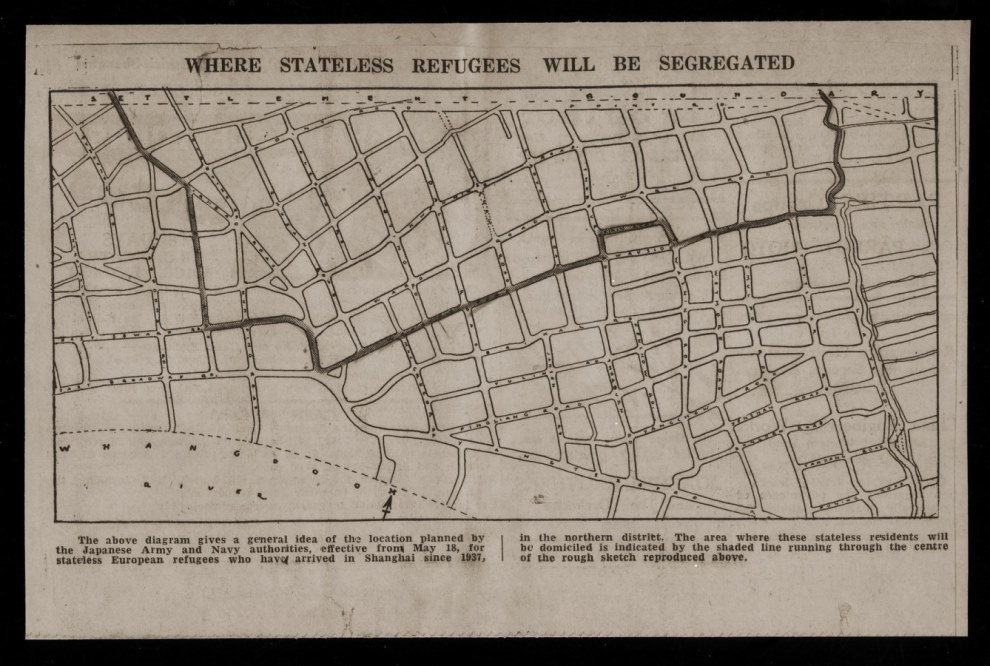
Map of the Hongkew Ghetto.
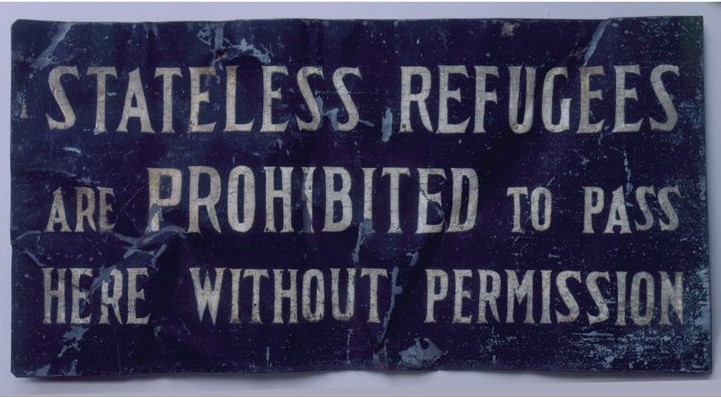
Sign at the boder of the ghetto.
There was panic among us all. The researcher will find in my papers the scrap book with the cuts from the newspapers, carrying the Japanese declaration and other articles. For me, however, a new difficulty brought out in me again the old warrior who fought difficulties all the time, in the factory in Vienna, in the patent courts in Europe, in Dachau and in Buchenwald, in Canada and now in Shanghai. At least I was together with Claire, and Claire was ready to share whatever fate would befall me. But other Christian wives were not so faithful. Some went to the German consul and asked for protection as Germans, and applied for a divorce. Some of them did it with the consent of their husbands, because they could thus keep their apartments and perhaps would be safe. Others however had enough of all the terrible fate of the Jews. They wanted a separation in earnest. These were terrible times for many couples. Fortunately, with me and Claire there was no problem. And I set to work. (SS 210-66)
Though we had three months’ time, and many believed that somehow the edict will not be carried out, I for one, hoped the best, but prepared for the worst. I realized that there will be a mad scramble for houses and rooms in that poor quarter of Hongkew, the “designated area”. Consequently, already at 8 a.m. in the morning, barely one hour after we read the terrible news in the paper, I was on my way to Hongkew with a sizable sum in my pocket as a deposit for a house. But a “house” in those quarters does not mean a house in the proper sense. Moreover, all you could buy was the thief tenancy. These small houses had usually six rooms altogether, which were rented out to two or three families, two rooms for each. I found a house in which a White Russian and his wife lived on the first floor in one room and a separate kitchen. Underneath him lived a Japanese man with a Chinese concubine and in the last two rooms lived a Jewish couple with their two grown-up children. All I could buy for the sum of $200 was the chief tenancy, which gave me two rooms and the rent from the other two tenants. When I told others the very same day what I did, they looked at me as if I was crazy. Why had I made such a quick decision? Perhaps everything will be straightened out. (SS 210-66)
Well, it did not happen. In consequence, others, for instance my cousin Paula and Kurt paid $200 for one single room, and others paid much more. Those three months from the 18th of February to the 18th of May 1943 were terrible months. When it became clear that rich Jews had been able to buy themselves out and retain their businesses and apartments, a mad scramble started for the favours of Dr. Kohn and the Japanese who controlled the whole exodus. But for most of the people it was of no avail. We had to move out from our small quarters in Bubbling Well Road and we moved into 416 Tungshen Road, Hongkew. We all were very much downcast, because we did not know how we would be able to make a living. Many believed that our end will come. There were already rumours of extermination camps in Germany, and people said the very same thing is going to happen to us now. (SS 210-66)
I had a few rolls of 8 mm film with me, and I said to Claire "Let's make a film of a day in our home, how we live, how we work, how we entertain our guests, and how we stay alive in our little two rooms in the International Settlement. And let’s call the movie “A Day full of Bliss” Because now as we had to part with our little apartment, it had become a sanctuary which we had loved. Whatever now the future will bring, we have to bear it somehow. And should we come out alive from the war, then this little movie “A Day full of Bliee” will remind us of those fearful, but also joyful days in Shanghai. As it happened, we came out alive and this little film has given us in Sydney much pleasure. It's still with me. (SS 210-66)
On the 17th of May we moved with our few belongings. I was already cheerful and hopeful and my researcher will find in my scrapbooks articles which I wrote for the Jewish papers in Shanghai and which were intended to give hope and courage to the others. Claire, my good companion and beloved wife went cheerfully too and so a new life was started by us and nearly 18,000 refugees in the new Ghetto of Shanghai. (SS 210-66)
The White Russian couple moved out and we moved in. But underneath us, that Japanese gave me a headache. He was a brute and known under the name “the Tiger.” How could I live with him under one roof without endangering my life? Another calamity to be solved and I solved it. There were many rooms, and double rooms free which were just outside the Ghetto area, and those Jews unfortunately living there had to move out. Immediately the Chinese landlords or chief tenants found Chinese people to move in. Somehow I believed if only I could find such a double room I might be able to induce the Japanese in my house to move. I then stood on the streets near the Ghetto and spoke to every Jew who came along whether or not he knows of such rooms. After weeks of search I found a house which belonged to a German woman, married to a Jewish husband. I agreed to manage the big house and collect the rents, and she in turn would take the Japanese in as a tenant. And so it came about that now I had two' rooms to myself which I could usefully employ as a business workshop or the like. I founded immediately such a business. In Europe housewives use “maggi Wuerze” a condiment to make soups and dishes tastier. I found that the Chinese soy sauce could be used similarly and made palatable to European taste by some added ingredients. And so I brought out onto the market my "Schmackhaft Wuerze" (tasty sauce) which provided part of our income. My researcher will find in my scrap books some of the funny advertisements which I inserted in the Jewish papers. (SS 210-67)
We were not allowed to leave the Ghetto. But the Japanese did net care very much, so little indeed that they recruited a corps of Jewish refugees who stood guard at all the roads leading out and in of the Ghetto. Some of the Jews were employed with Japanese firms, some with others taken over by the Japanese. For others influential people applied to the Japanese that day passports be given to some Jews. Needless to say that I too soon acquired such a day passport. But I had no office. Through my lectures I had made friends with one of the best portrait photographers of Shanghai, a Jewish man from Russia, who was known under the name of Josepho. He allowed me to use his downtown studio as an office. Already in the Bubbling Well Road I had obtained the services of a Phillipino girl Christina. Now I employed her in my new office because I had to be away most of the time hunting for cameras and sometimes even for an editing and titling job with some wealthy Frenchman, Swiss, or Italian. She then stayed on in the office in case someone came. My income was meagre indeed, and I did often not know where the money for the next week's feed will come, but somehow I managed. Claire and I needed so little, I had bought a secondhand bike and thus was independent of public transport, the trams which were always terribly overcrowded. And so during the hot summer months and during the great cold of the winter, I would pedal through the streets and hunt after the pennies. I had even managed to get my Roumanian nationality “back” on the basis that I was born in Czernowitz, now Roumania. In fact I could even move back into the Western sector, but all the money I had saved went into buying the chief tenancy of that little house of ours, so we stayed on (SS 210-67)
Meanwhile the war news was good news indeed, and we had maps and red crayons and marked every day the advance of the allied armies. But nevertheless our fate in East Asia was in the hands of the Japanese, and they would be ruthless. In1944 I realized that America is going to make an all-out effort to recapture everything from the Japanese. I realized too that American and British bombers are bombing an allied land France into shambles, causing the less of life of many thousands of Frenchmen. And so I said that we too will be bombed by American bombers. Of course, everybody laughed at me, and when I decided to build an air raid shelter in my house, everyone thought I am crazy, or how much money have I really to threw away. Well, I built the shelter and the bombers came. One day, I was downtown and heard the bombers coming over Hongkew and heard the dull detonation of bombs. There was a radio station quite near our house and I always feared that this radio station will be a target. Like mad I pedaled home, only to see that my worst expectations seemed to come true. Houses were on fire at the corners, and dead people were laying around. I turned the corner to our home, and with utter relief saw that it was still standing and Claire and our little cats alive, but scared. There was fire all round, and they and neighbours were in the air raid shelter when the bombs did fall Now we had to' pack and flee, because the conflagration could soon consume our house, I had prepared for this eventuality too, and had in readiness a small trailer with two wheels, onto which I now leaded our suitcases and in one the mother cat and the young one, and so we fled to an open space. Fortunately we could return in the evening. The fires were under control but more than 40 refugees and hundreds of Chinese were dead or seriously wounded. Nevertheless we realized that the war is coming to an end, and we only hoped that we shall be able to stay alive. (SS 210-67)