Marriage and name change from Blitz to Bliss.
Charles' name of Blitz has terrible connotations during the war (Blitz of London, Blitzkrieg). So one of the first things he does when Claire arrives is to secure a name change to Bliss.
Now something must be told, and I am glad I can tell it. In Vienna I had to keep up some pretenses on account of my poor mother, who still hoped that I shall make a good marriage and have Children and grandchildren for her. So, we lived in Vienna as many thousands did as “Lebensgefaehrten” a legally recognized title, “Comrades for life.” But now everything has changed. We simply could not risk another separation. We could be interned, then better together, as man and wife. We decided to get married. On the steamer from Vancouver to Shanghai I had made friends, some of the American community in Shanghai, notably Mrs. Morris, the headmistress of the American school in Shanghai. Many a times I was invited to their home. I wrote an article on high-speed photography for the North China Daily News and she was asked by me to correct it, I was jubilant when she found nothing to correct, She praised my ability to write and made me very happy. The article appeared, and I received congratulations from influential men of the community of Shanghai, who later on became my customers. My researcher will find two scrap books in my estate which contain my literary and business activities in Shanghai, and he will find there the article too. (SS 210-62)
As soon as Claire arrived, I brought her over to the home of Mr. and Mrs. Morris. It was then a natural that we confided in her about our plans to get married. I and Claire refused to be bothered with the idiocies of a Jewish or Roman-Catholic conversion. Mrs. Morris was a member of the Community Church of Shanghai which catered for all denominations and even for non-Christians. And so one evening, the 25th of January 1941, one month after Claire arrived in Shanghai, there was a small but beautiful ceremony in the home of Mr. and Mrs. Morris in the American school. The reverend was there and his wife. He read to us the well-known phrases, and we both answered with “'I do!” Until death do us part - this has come true now 20 years later. We have been faithful to each other before and afterwards, until death did us part, and even over our graves will our love go on flourishing. (SS 210-62)
Then the reverend turned to Mr. and Mrs. Morris, our witnesses, and said simply: “Meet Mr. and Mrs. Bliss!” Already in England I was told that I had to get rid of that terrible German name of Blitz, which reminded everyone of Hitler’s terrible Blitz and Bombs. So I changed to Bliss, and did this then legally in Australia. In the International Settlement I was told by the legal department that I can change my name without permission. And then Mr. and Mrs. Bliss, Mr. and Mrs. Morris, and Mr. and Mrs. Lyon, the reverend of the Community Church Shanghai had a quiet and beautiful dinner with candle lights and lots of flowers and happiness all round. It was a real crowning of all our endeavours to escape the Nazi hell and be united again. From the name of Blitz to the sweetness of Bliss, of utter happiness. My new name was very appropriate and I liked it very much. (SS 210-62)
Slowly my business began to flourish. Money came in and I could not only have a cook boy, but also a typist. Claire handled now the accounts and the money and the film splicing and other activities, and she did everything expertly. Slowly too we began to like our life in Shanghai, The small front room was our office, living room and at night our bedroom. A large built-in wardrobe separated it from the kitchen which was also my darkroom, our dining room and also our bathroom, There was a tiled bathtub in one corner. I put a wooden cover over it, and this was our dining table. Once a week we would have a hot bath. This is done in Shanghai by going to the nearest hot water shop and ordering 4 or 6 buckets of hot water. At 8 p.m. two Chinese water bearers would come with long wooden poles and carrying a bucket on each end. It was not much water for a bath, but it was sufficient for Claire first and then for me, to clean ourselves and then wash off with cold water afterwards. We would go out in the evening and visit friends, or to a Chinese restaurant, or to a movie. Shanghai at night was the most fantastic city I have ever seen. The streets carried many neon lights in all colours. Whole department stores, and their towers were outlined in beautiful coloured neon lights. And all the curiously shaped Chinese characters in gleaming light would add a fairy atmosphere to a fairy city. (SS 210-62)
As a true traveller who likes to see things new and exciting, I liked Shanghai from the start. Perhaps it was so, because my expectations were of a dreary and miserable city in the Far East with primitive living conditions and dangerous health conditions. Instead I saw beautiful streets with beautiful shops, first- class apartment houses towering over villas and cottages in beautiful gardens. I realized that there are wealthy people in Shanghai and that I should not have any difficulty to make a living here. Nevertheless, I did not want to stay in Shanghai forever. I wanted to emigrate to America. Again there was an industrialist who wanted to get me over for a tungsten business, a Mr. Gutmann. He did what he could to get me an entry permit, but it was again my Roumanian quota which made it difficult. I had to wait and see. The very same thing happened to the 18,000 Jewish refugees who were in Shanghai, They were a mixed lot. About one third brought some money and had started some businesses, shops and even factories. Another third of them went into employment in the many offices, shops and factories in Shanghai. But the last third of the refugees, about 6000 of them thought that it could not last long. Why go into business, why go into employment, why not wait for the entry permit. In the meantime the Jewish relief organization in America sent millions of dollars. Old factories were converted into dormitories and eating rooms and thousands of refugees with their women and children were crowded there. Others lived in smaller houses, and all these “homes” as the factory dormitories were called, and the other houses of refugees were concentrated in the Hongkew sector of the International Settlement. But what to do with the whole day? And sure enough, dozens of cafes Vienna-style sprang upon almost every street corner where the idle goers would sit, read the papers, discuss the political situation drink their coffee and play chess or card games. In the evening there were dancing restaurants, all quite primitive, but nevertheless quite gay. Every one of these refugees got some money from the welfare fund and everyone was hopeful that sooner or later the entry permit for America or another country would arrive and then they would leave that hateful city of Shanghai forever. (SS 210-62/63)
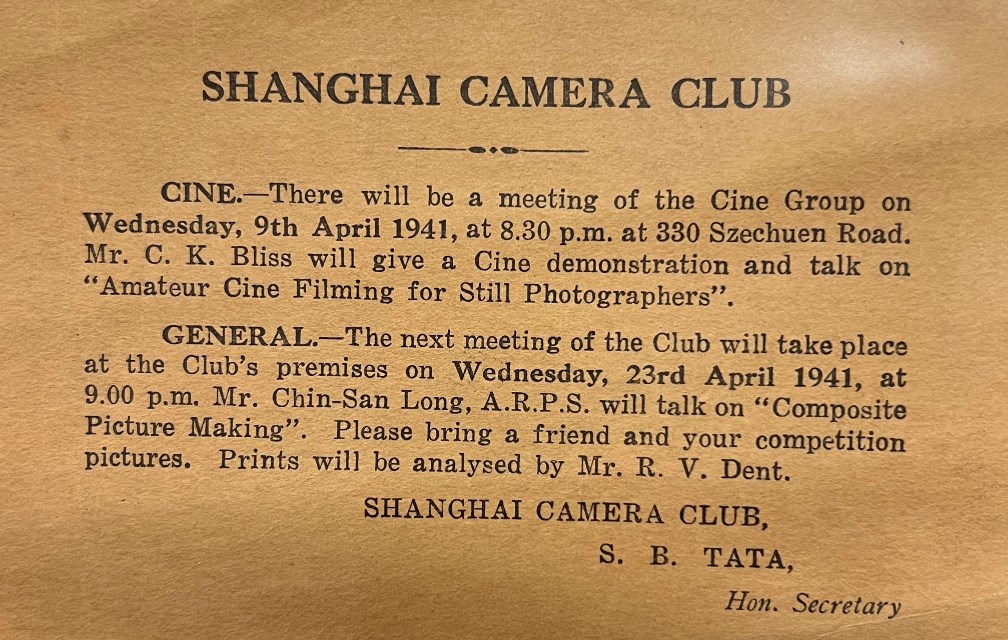
Charles is giving lectures on a wide range of topics and in front of a range of organizations.