Emigration Aid Action Gildemeester
Charles writes that Clair was working for Charles‘ release through Dr. Van Baren, a Dutch soliciter located in Vienna. Dr. Van Baren was working with Frank van Gheel-Gildemeester, who was founder of “Emigration Aid Action Gildemeester”.
Note: This is a summary of a brief research. It is partially annotated, but information on Gildemeester can be found via an Internet seach.
Born in 1881 in the Netherlands, Frank van Gheel-Gildemeester was the son of a wealthy Dutch family. He joined the Society of Friends (Quakers) in 1915. Post World War 1, on behalf of President Herbert Hoover he worked for the release of politcal prisoners and the liberation of prisoners of war in central and southeastern Europe. .
In 1924, along with Dirk van Houten, Gildemeester founded the “Baugesellschaft für Privatschulen mbH” (Construction Company for Private Schools Ltd.) and in 1925 the Hollandsche Buitenland-Bank in The Hague. These organizations inconspicuously provided German funds for German minorities in Poland..
“As a Quaker, we know no differences between countries or political sentiments. I have obtained the release of socialists by the Nazis in Germany and now expect an amnesty for Germans in Czechoslovakia who have been imprisoned by the Czechs as Nazi sympathizers.”
Frank van Gheel-Gildemeester died 27 March 1934
Gildemeester emigrant aid campaign for Jews
After the Austrian Anschluss on 12 March 1938 Gildemeester founded the “Gildemeester Emigrant Relief for Jews”. His organization first attracted little attention until he renamed it “Emigration Aid Action Gildemeester” in September 1938, with the declared goal of helping wealthy Jews Reichsmark who owned 100,000 Reichsmarks or more and wanted to leave Austria. They had to be willing to donate from their assets to the action. In return, the action should be used to finance the emigration of poor “non-Aryan” families through the educated Gildemeester Fund. Questionnaires were another important source of income, as they cost 60 marks per piece and every prospect had to fill it out. Frank van Gildemeester’s deputy was the Jewish industrialist Arthur Kuffler. Until March 1938, Kuffler was director of the Pottendorf Spinning Mill and representative of the textile group Mautner AG in Prague as well as other textile companies in Czechoslovakia and Hungary. He brought high initiative into the action and had a network of very good contacts. Another well-known employee was Emil Gottesmann. A member of the Republican Protection Association, after 1934 working for the illegal Revolutionary Socialists. In November 1943 he was deported to Theresienstadt and from there on 29. September 1944 to Auschwitz, until he was liberated from a side camp in Dachau in 1945.
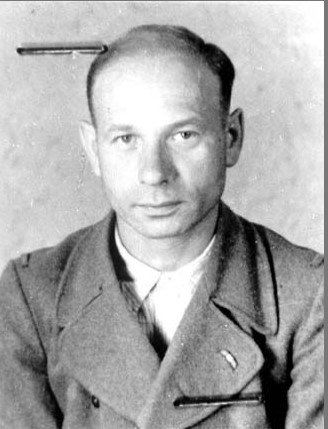
Emil Gottesmann
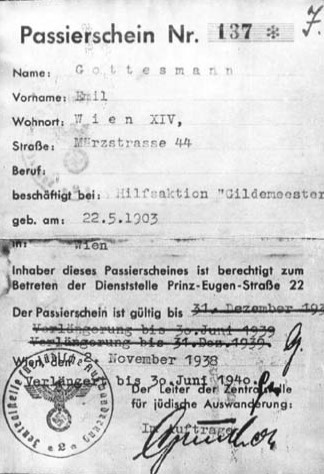
Pass for Emil Gottesmann, employee of the "Aktion Gildemeester", which is what he has allowed to enter the "Central Office for Jewish Emigration"
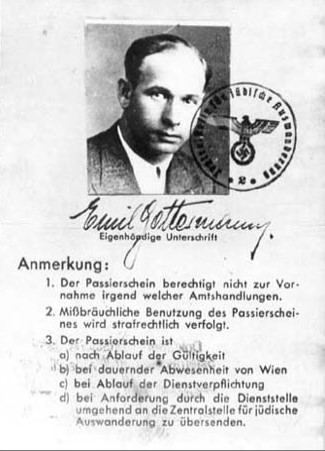
Pass for Emil Gottesmann, employee of the "Aktion Gildemeester", which is what he has allowed to enter the "Central Office for Jewish Emigration"
"We from the "Gildemeester" advised the people, and if someone wanted to emigrate, we provided him with the necessary forms and documents in the Prinz-Eugen-Straße. Through our help, many were able to emigrate to Shanghai, Colombia, Italy, Switzerland. Mainly overseas, to Shanghai many have emigrated. – Emil Gottesmann : Documentation Archive of the Austrian Resistance.
The emigration to Shanghai was supported in a special way by the Chinese diplomat Ho Feng Shan. As an employee of the Chinese Consulate in Vienna, he issued visas en masse as proof of emigration for Jewish refugees. With this obligated proof, the Aktion Gildemeester was able to organize the further modalities for emigration.
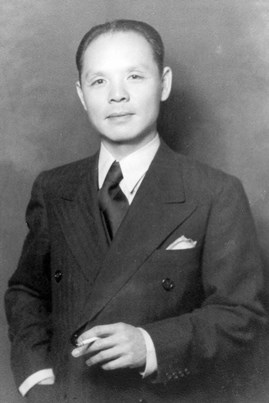
Ho Feng Shan
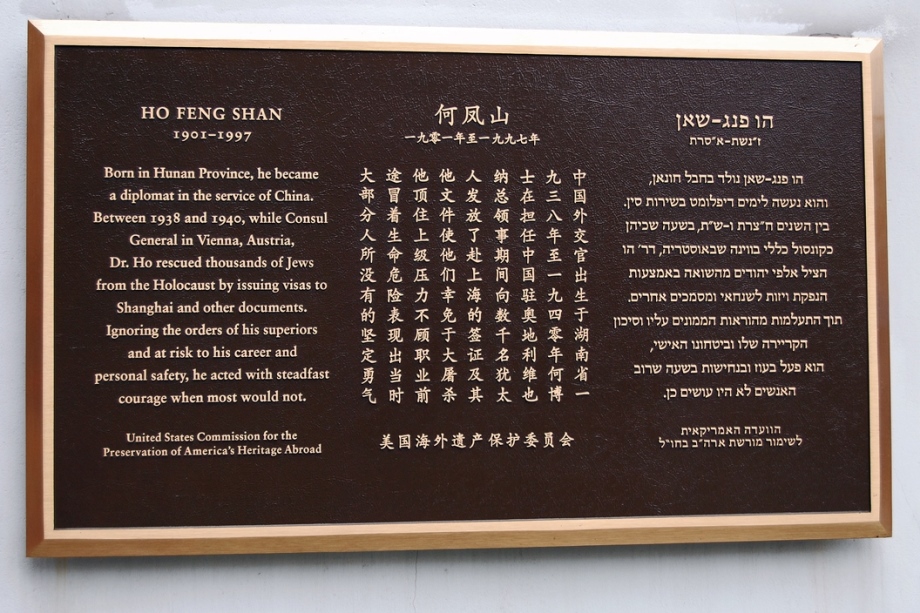
Ho Feng Shan plaque (Shanghai Jewish Refugees Museum)
Note: Charles did not utilize the office of Ho Feng Shan to get to Shanghai. Charles went to the UK, with the plan to bring Claire over at the first opportunity. The advent of the war destroyed all those plans. Also, Charles does not say how the services were paid for. Prior to his arrest he was living in Vienna with Claire. His extended family was in Roumania and so were beyond the reach of the NAZI aryanization of Jewish assets. It appears that Claire used all of her money to get Charles out of Buchenwald and safely to the UK, and had to move to Czernowitz out of financial necessity. Claire lived in Czernowitz with Charles' family.
In 1952, Frank van Gheel-Gildemeister died in the Netherlands.
Summary of Emigration Aid Action Gildemeester
Who was it for:
Unlike the institutional Jewish Community (Israelitische Kultusgemeinde), which primarily assisted religious or practicing Jews, the Gildemeester Organisation specifically targeted non-confessional, non-religious, or converted Jews, as well as those classified as "non-Aryans" or Mischlinge (mixed race) under the Nuremberg Laws
How it worked
Gildemeester received permission from Adolf Eichmann to operate in Vienna. Because Gildemeester had previously provided philanthropic aid to imprisoned Austrian Nazis when they were banned under the pre-1938 Austrian regime, he possessed a unique degree of leverage with the Nazi authorities.
The organization functioned via a controversial funding structure:
Wealthy Emigrants: Wealthy "non-Aryan" families were forced to turn over management of their entire properties, businesses, and assets to a designated trustee bank (such as Bankhaus Krentschker in Vienna).
The Cross-Subsidy Fund: A certain percentage (often around 10%, some sources say 5%) of these confiscated assets was redirected into a Gildemeester fund intended to finance the passport and travel costs of impoverished Viennese Jews who otherwise could not afford to flee>
The Reality: While the system did successfully facilitate the physical escape and emigration of thousands of people, it ultimately acted as a pseudo-legal mechanism for the Nazi state to smoothly plunder and "Aryanize" Jewish assets.
Controversy
Historians view Frank van Gheel-Gildemeester with a blend of skepticism and nuance. To the Nazis, his organization was an efficient pipeline to accelerate the expulsion of Jews and strip them of their wealth. To many contemporary observers and historical critics, his willingness to sign letters with "Heil Hitler" and interface directly with the Gestapo drew immense distrust. However, for thousands of "non-Aryan" Austrians who were trapped with no institutional support, the Gildemeester action was their only viable exit out of Nazi German.
Estimates as to the number of Austrian and German Jews that emmigrated due to the work of the Gildemeester campaign ranges from 26,000 to 30,000. Peter Berger states that Gildemeester, even though the appearance may have spoken against him, has never benefited financially from the relief work.
Because Gildemeester had to negotiate directly with the Nazi authorities—specifically Adolf Eichmann's Central Agency for Jewish Emigration—post-war historians and contemporary Jewish circles frequently viewed him with suspicion, with many considering his operation a tool or mechanism of the Gestapo to efficiently strip Jewish citizens of their property.
Quotes
Hans Adolf Schmitt: “whom some contemporaries identified as philanthropists, while others regarded him as a blackmailer who primarily protected Jews who could pay for his services.” (In Quakers and Nazis: Inner Light and Outer Darkness), New York: Columbia University Press, 1997, p. 137)
Norman Bentwich: “Gildemeester was a well-meaning but eccentric Dutchman. A social worker who had acquired the favor of the Nazis when he befriended the Austrian Nazis during the Social Democratic regime.”
Hans Safrian belongs to historians who are opposed to Gildemeester in Die Eichmann-Männer (Vienna, Europa Verlag, 1993) and Theodor Venus and Alexandra-Eileen Wenck in The Deprivation of Jewish Wealth as part of the Gildemeester campaign. An empirical study on the organization, form and transformation of Aryanization and Jewish emigration in Austria 1938–1941, Vienna: Oldenbourg, 2004; Hans Schmitt, Quaker and Nazis: Inner Light and External Darkness, New York: Columbia University Press, 1997.