Release from Buchenwald and Arrival in England
"Now for the first time, I saw something which appeared to me as the most beautiful thing on earth: the Union Jack flying high from the air terminal. For me it was a wonderful symbol of Freedom and a new Life.">
Charles is released from Buchenwald, but happy reunions are short-lived. Charles must report daily to the Gestapo and must get out of the country within a few weeks.
But I am still standing on the ground of Buchenwald Concentration camp and all these thoughts never entered my mind. All I hoped now was that there should be no practical joke at the railway station, and we shou1d not be turned back as released inmates have experienced this before. At last one of the Gestapo men gave us a farewell address. He warned us in the strongest words that we must not breath a word about our experiences in the camp, even overseas, “Unser Arm ist lang” he said , “our arm is long, and we shall get you back into camp even from the U.S.A. and then you will not come out again alive.” We took this very much to our heart and this too is the reason why I am telling now all I remember, so that future generations may realize the terrors of totalitarian dictatorship. And now at last we boarded civilian buses, and sitting upright we drove through the Buchenwald, the beechwood which is the Ettersberg near Weimar, where Goethe, Germany's greatest poet used to walk. But we were not prepared for what happened then at the railway station. Suddenly many well-clad men and women came upon us, and offered us food and delicacies, and sweets and cigarettes and advice and information, taking down the names of our fami1ies whom they are going to cable of our arrival. It was the Committee for released Buchenwald prisoners of the Jewish community of Weimar. This sudden onrush of friendly people overwhelmed us. So far we had encountered only the most savage brutality, and we all wept unashamed at all the love thrown upon us. And then we were sitting in a good railway coach and the train moved on, and on, through the night coming nearer and nearer to Vienna and my Claire. It was all unbelievable. And then we were in Vienna and Luschi' s people were at the railway station and took me to their home. And an hour later, Claire arrived. Here forgive me if I simply feel I cannot describe the storm of emotions which swept over us. We cried and cried holding tight, and all the terrible unhappiness and terror of 13 months of indescribable torture was washed out of our hearts. (SS 210-43) .
Charles sees his mother for the last time. He wears a hat to cover his shaved head, and by doing so hopes to conceal the fact that he was incarcerated in Dachau and Buchenwald. For years he thought he got away with it but in later years family reveal that his mother told them that she knew exactly what had happened him.
Then we began to tell of our experiences and our troubles, and our future plans. But I had important things to attend, and I lost not a minute. I had to report at the Gestapo and at the local police station every day about my progress of my departure overseas. Claire had secured a British entry visa through my friend Mr. Rath in London and I wanted to go to England first and then perhaps overseas. Claire, of course could not come with me. This would be very dangerous for me and for her. Only once did I come into our old home, and then in the dark of the evening. Claire told me of the Nazi overseer who administered the few blocks of cottages where we lived. Time and time again he came to her asking harshly “Is the Jew gone already?” Here indeed, the age difference saved Claire and myself. She could always maintain that she is only the landlady and she keeps only my clothes and personal things until I return from Buchenwald and go abroad. When I opened my wardrobe and saw all my clothes and all things just as I left them 13 months ago, I simply could not believe that all that great nightmare ever happened. But when I looked into the mirror and saw my shaved head I knew that all had been real, and that the danger is still real. I had to pack and get my exit visa with utmost speed. I did not go near my firm, afraid that the Nazis there would catch me again. But I happened to run into our sales manager Mr. Modley, also a Jew, and also incarcerated by the Nazis who told me that Dr. Dukes, my former chief is in London too. Indeed, he spoke to him on the telephone from Vienna to London the very next day and informed him of my coming. His brother rushed to the airport - but this is another story. My mother had arrived from Czernowitz, still not knowing that I was a prisoner of Hitler, but sensing something. At the Airport, she and Claire and my aunt Hermine said Good-bye to me. For my dear Mama, it was a Good-bye forever. She had lived through the Nazi horror and Russian and Roumanian terror, and then emigrated to Seret, a small town in the Bukowina. And there in the knowledge that she will soon join her eldest son in Australia she died in 1947 but she died in her bed, as my brother Isiu had died in his bed in 1946 and was holding the hand of her best son, my brother Henry. But my aunt Hermine suffered the worst fate. Her three children had to flee separately and had no means to take her with one of them. She remained alone in Vienna. Her eldest son Karl (now in Sydney) went into hiding when the Nazis came to Austria. Five days later I was in the hands of the Gestapo, but Karl walking the streets, and not daring to come home, many a times rang up Claire late in the evening, and asked if he could come and sleep there. For Claire and for me, this might have been a terrible risk and a terrible danger. But nevertheless Claire had the great stature of a woman of courage, and in the dead of night she let Karl in, gave him a good meal, a good bed, a good breakfast before the dawn came, and let him out. The cottage where we had our home stood solitarily in a meadow, and everything which happened there could be seen from all the houses surrounding this meadow. Yet, Claire braved all the dangers in order to help my cousin Karl. He managed to come to London, then his wife Mary followed him there, and together they went to Sydney. Hermine's second child Paula, went to Shanghai, when her fiancé sent her the ship ticket. She again could not take Mama with her, and her youngest child Willy, a small boy went to England with a children’s rescue action from Great Britain, So, poor Hermine was left alone, and then the inevitable happened. The Nazis rounded her up and sent her to an extermination camp Riga, where she was murdered. (SS 210-43-44) .
But now she, my mother and Claire were standing on the roof of the air terminal, watching all the passengers board the plane, and wondering when I will come out. Claire sensed again something terrible and she was right. The last drama of Nazi terror was enacted down below and I was the victim. I had refused to go to the Dutch frontier by train. Too many times Jewish emigrants had been seized by the Gestapo at the frontier and sent back to a concentration camp. I believed it will be better to face the last Gestapo official in Vienna, where he could always ascertain at Gestapo headquarters that I am to be released for emigration. My passport bore the usual large letter J, meaning Jew, but there must be a secret mark for those who had been inmates of a concentration camp. Because, as the Gestapo man took all the passports from the passengers for rubber stamping, as soon as he took a look into my passport, he simply threw it away and into a corner of his office. For me, the day turned suddenly into night. My face went white all the blood drained into my leaden feet. I leaned against the wall, closed my eyes and one thought hammered in my mind “I am going back to Buchenwald! I am going back to Buchenwald!” Meanwhile the minute of departure had arrived. The Gestapo man, who saw my trembling and my white face, apparently had enough of sadistic pleasure. He picked up my passport and threw it at me. I grabbed it, and run, run, run out on the tarmac, waved once more to the three women on the roof, and clambered up the stairs to the plane and fell into my seat, still trembling violently. (SS 210-44) .
But now she, my mother and Claire were standing on the roof of the air terminal, watching all the passengers board the plane, and wondering when I will come out. Claire sensed again something terrible and she was right. The last drama of Nazi terror was enacted down below and I was the victim. I had refused to go to the Dutch frontier by train. Too many times Jewish emigrants had been seized by the Gestapo at the frontier and sent back to a concentration camp. I believed it will be better to face the last Gestapo official in Vienna, where he could always ascertain at Gestapo headquarters that I am to be released for emigration. My passport bore the usual large letter J, meaning Jew, but there must be a secret mark for those who had been inmates of a concentration camp. Because, as the Gestapo man took all the passports from the passengers for rubber stamping, as soon as he took a look into my passport, he simply threw it away and into a corner of his office. For me, the day turned suddenly into night. My face went white all the blood drained into my leaden feet. I leaned against the wall, closed my eyes and one thought hammered in my mind “I am going back to Buchenwald! I am going back to Buchenwald!” Meanwhile the minute of departure had arrived. The Gestapo man, who saw my trembling and my white face, apparently had enough of sadistic pleasure. He picked up my passport and threw it at me. I grabbed it, and run, run, run out on the tarmac, waved once more to the three women on the roof, and clambered up the stairs to the plane and fell into my seat, still trembling violently. (SS 210-44) .
As the plane rose, we soon came into clouds, and were in clouds all the time. I calmed down, but somehow I realized that as long as the plane is over Germany I am still not safe. We may have an emergency landing somewhere in Germany. The plane was scheduled to land in Prague (also in German hands) and should be in Rotterdam in 6 hours from Vienna. So I settled down for six anxious hours. But when 4 hours had passed, and we had not landed in Prague and the plane always in clouds and bad weather all round, I suddenly looked at the altimeter, and saw to my consternation the needle going down, down, down, until the plane was below 1000 meters. This could mean only one thing: emergency landing in Germany. And sure enough the hostess came up and told us to fasten our belts. The altimeter showed only 300 meters. “Where are we going to land?” I asked her anxiously. “Why, in Rotterdam!” she said smiling, “we did not stop over in Prague.” And at that moment the plane broke through the clouds and I saw suddenly the rows of neat Dutch houses, the polders, the windmills which I knew so well, and then we rolled onto the tarmac. I clambered down and stood for the first time not on Nazi territory. I was free at last. My feet trembled. I did not want to throw myself down and kiss the ground as Herrmann Leopoldi had done in New York (Note: Herrmann Leopoldi was an Austrian composer and cabaret singer. Like Charles he incarcerated in Dachau and then Buchenwald. He was released following a bribe paid by his wife). He was a show businessman and the reporters and photographers wanted him to do just this. But I had no yearnings for publicity. I had time to send a telegram to Claire and Mama, and pick up £10 which I had asked in writing to a Dutch business friend to deposit for me at Rotterdam airport, because I could not take any money out of Germany. And then I boarded the plane again and we landed in London airport when dusk fell. Suddenly I saw something which made my heart beat fast. For more than 13 months I had always seen the blood red Nazi flag, together with the dead black SS flag waving above me. Now for the first time, I saw something which appeared to me as the most beautiful thing on earth: the Union Jack flying high from the air terminal. For me it was a wonderful symbol of Freedom and a new Life. Soon I had a ticket from the Jewish welfare organization, a .free bed at the Salvation Army in Whitechapel. There I got a small cubicle and a clean bed, all for myself. A king could not have a more luxurious bed. And with the most happy thoughts in my mind I fell asleep. (SS 210-44) .
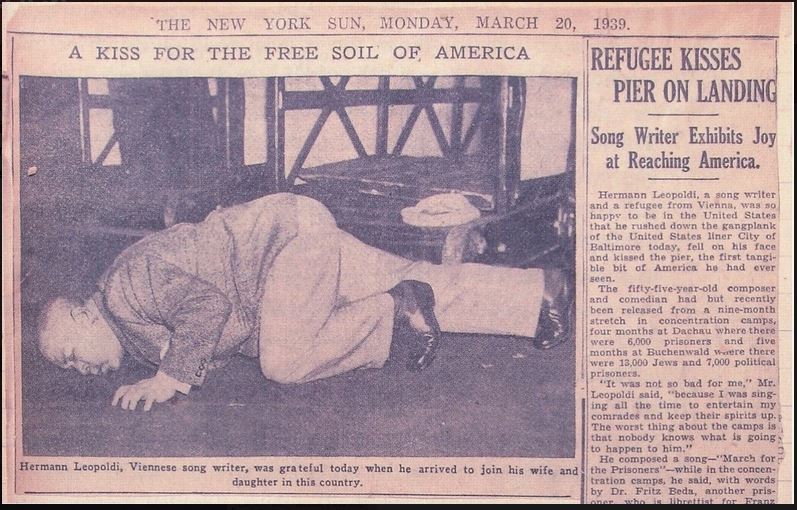
Herrmann Leopoldi